A Labour Dispute at Prince Rupert Is Rerouting Western Canada’s Coal
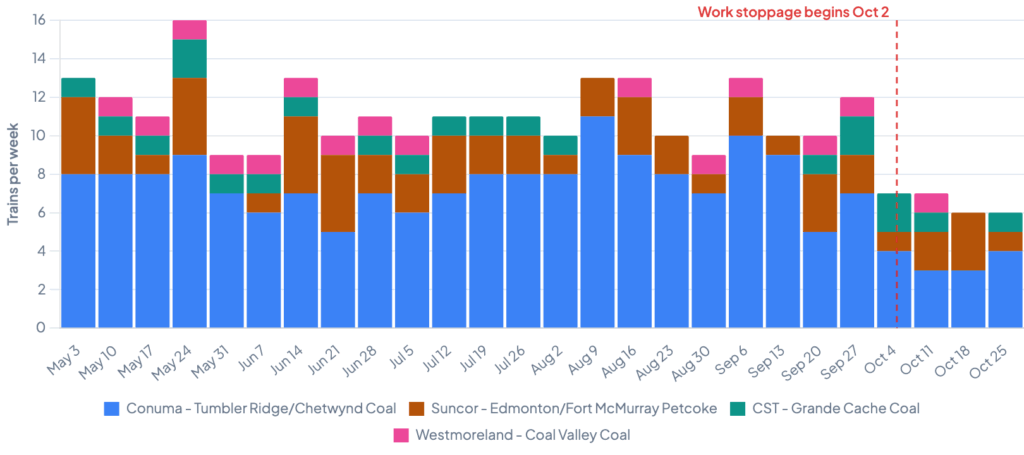
Coal trains into the Trigon terminal have fallen by almost half since workers stopped work on October 2. For the first time RailState has observed, two of Trigon’s regular shippers are sending trains to Westshore Terminals at the Port of Vancouver instead.
At a Glance
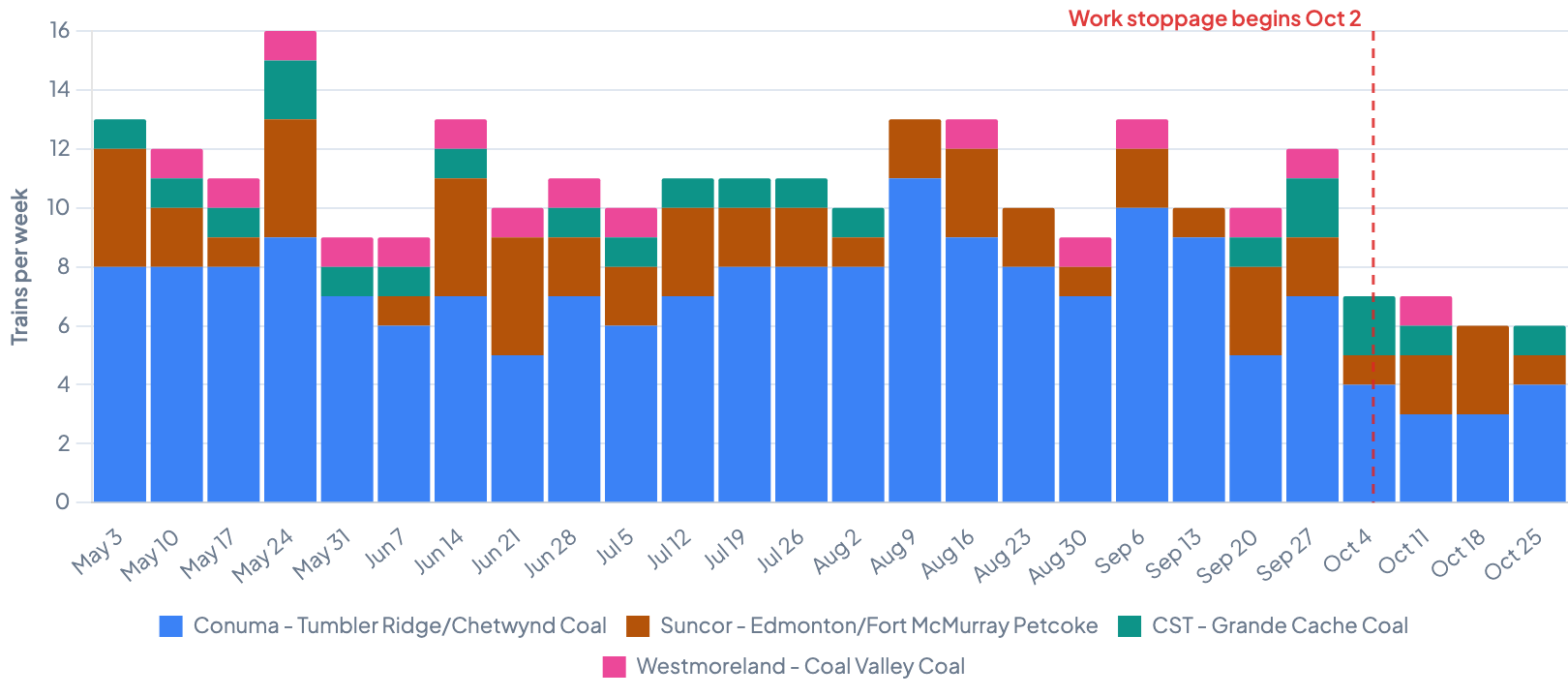
- Coal and petroleum coke trains into Trigon fell 48%, from 11.2 a week in August and September to 5.8 a week from October 2 to 25.
- Conuma Coal, Trigon’s largest customer, went from 8.1 trains a week to 2.9.
- Between October 18 and 25, three trains from Trigon customers Conuma and Westmoreland arrived at Westshore. RailState had not seen trains from either company there before.
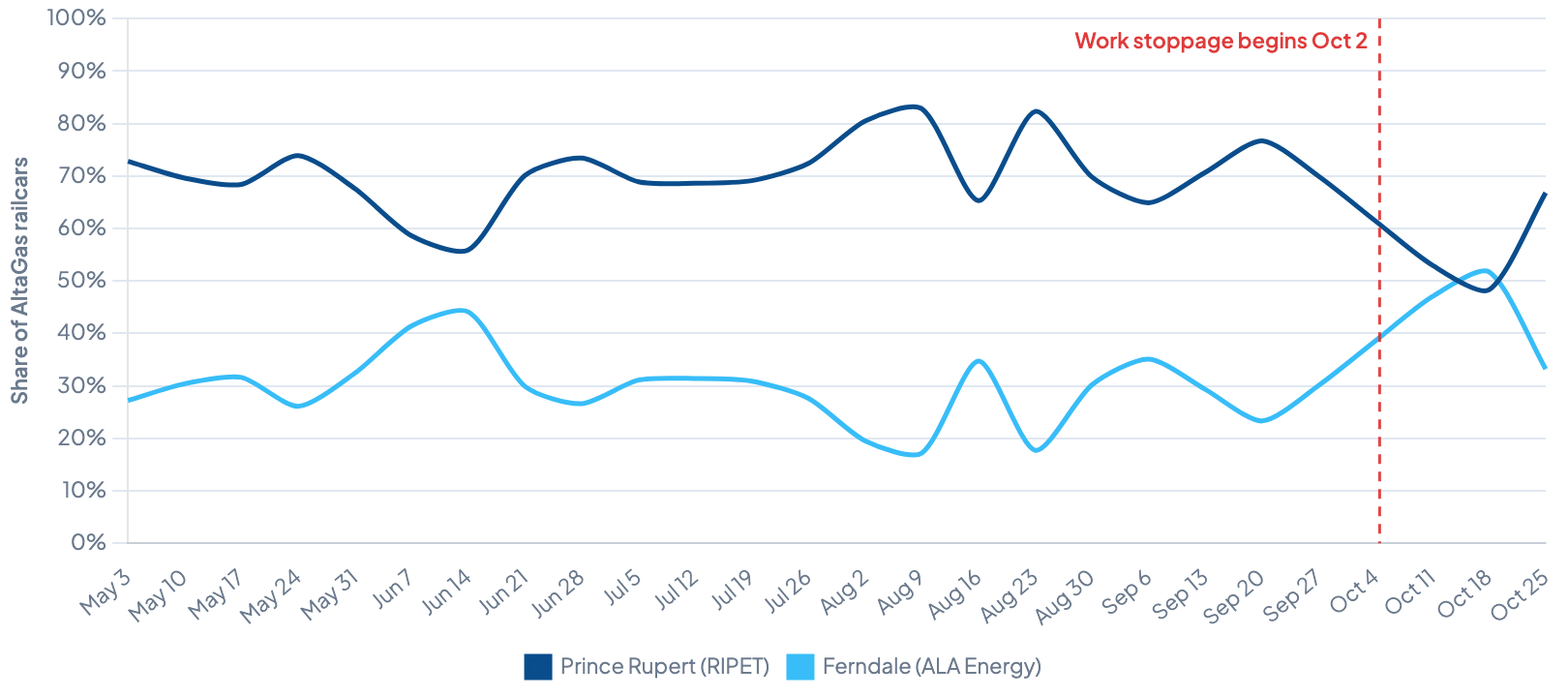
- AltaGas moved some propane shipments from Prince Rupert to its terminal in Washington State. By the week ending October 25, most of that volume had returned.
What Is Happening at Trigon
Trigon Pacific Terminals at the Port of Prince Rupert loads coal and petroleum coke onto ships for export and employs about 150 people (Chamber of Shipping). Petroleum coke is a solid, carbon-rich by-product of oil refining that is used as fuel and in industrial processes.
On October 2, members of International Longshore and Warehouse Union (ILWU) Local 523 began a work stoppage at the terminal. The dispute is over pay and the role of automation. Trigon says base-level operations are continuing (The Northern View).
On October 20, the Canada Industrial Relations Board, Canada’s federal labour board, unanimously dismissed Trigon’s complaint that the union had not bargained in good faith. The ruling confirmed the work stoppage is lawful and removed the company’s main legal challenge. Several related complaints remain before the board, and there is no end date in sight (Chamber of Shipping).
How We Track It
RailState’s trackside sensors read every railcar on every train heading into the terminal. That lets us see the dispute’s effect on shipments as it happens.
Most of this coal moves in unit trains: long trains in which every car carries the same commodity from one origin to one destination. RailState works out which company a train belongs to from three clues: where the train is first seen on the rail network, the type of railcars it is made up of, and its length compared with each shipper’s usual trains.
Coal Trains to Trigon Have Nearly Halved
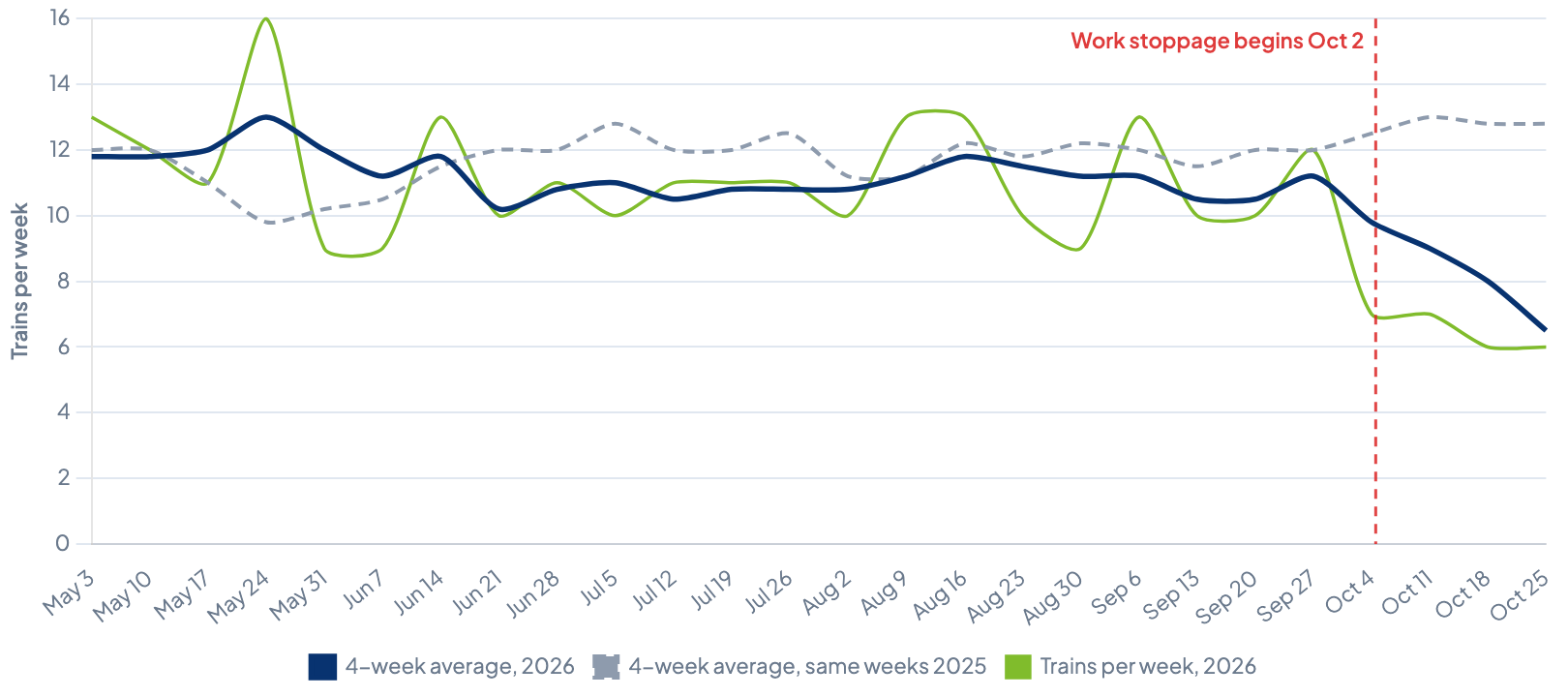
In August and September, Trigon received an average of 11.2 coal and petroleum coke unit trains a week. From October 2 to 25, it received 5.8 a week, a drop of 48%.
Most of that decline comes from Conuma Coal, Trigon’s largest customer. Conuma sent 8.1 trains a week before the work stoppage and 2.9 a week since, a drop of 64%.
This Is Not the Usual Autumn Pattern
The drop is not seasonal. Last year, Trigon’s arrivals rose at this time of year, from 12.0 trains a week in August and September 2025 to 13.1 a week from October 3 to 26, 2025.
Trigon’s Shippers Try Westshore
Westshore Terminals at the Port of Vancouver has seen its regular traffic from long-standing Canadian and US shippers carry on as usual, at about 29 trains a week.
What is new is coal from Trigon’s customers. A train of Conuma railcars arrived at Westshore on October 18. A Westmoreland train followed on October 20, and a second Conuma train arrived on October 25. These are the first trains from either company that RailState has confirmed at Westshore. A second Conuma train suggests that Trigon’s shippers are testing other routes while the dispute continues.
The table below compares each company’s trains to Trigon since the work stoppage began with a typical period of the same length.
Conuma and Westmoreland Coal Trains, October 2 to 25, 2026
| Shipper | Trigon, typical 24 days (trains) | Trigon, Oct. 2–25 (trains) | Change at Trigon | Westshore, Oct. 2–25 (trains) |
|---|---|---|---|---|
| Conuma | 22.8 | 10 | −56% | 2 |
| Westmoreland | 3.4 | 1 | −71% | 1 |
The work stoppage had run for 24 days as of October 25. “Typical” is the average number of trains Trigon received from each company in any 24-day period between January 2024 and October 1, 2026.
What About Propane?
Coal is not the only commodity that reaches Prince Rupert by rail. AltaGas’s Ridley Island Propane Export Terminal (RIPET), Canada’s first propane export facility, is also at the Port of Prince Rupert. It loads propane brought by rail from Alberta and northeast British Columbia onto ships bound for Asia (AltaGas).
The two terminals share rail access, since RIPET sits inside the loop of track that serves Trigon. RailState’s data shows some shifts in AltaGas’s shipments to Prince Rupert since the work stoppage began.
AltaGas has a second outlet, its Ferndale terminal in Washington State. In August and September, AltaGas shipped about 975 railcars a week of liquefied petroleum gas (LPG, mostly propane) to Prince Rupert and 397 to Ferndale. That is a split of roughly 71% to 29%.
During the first three weeks of the work stoppage, the balance moved toward Ferndale. Prince Rupert averaged 805 cars a week and Ferndale 686, cutting Prince Rupert’s share to about 54%. The low point was the week of October 12 to 18, when Prince Rupert’s share fell to 48%. The next week, October 19 to 25, it rebounded to 67%, close to its usual level. The shift may prove short-lived.
What We Are Watching
The dispute is unresolved, and proceedings before the labour board continue. RailState’s sensors will show the next moves as they happen:
- Whether Conuma and Westmoreland coal trains return to Trigon
- Whether trains to Westshore become a regular pattern
- How AltaGas splits its shipments between Prince Rupert and Ferndale
Each of these will appear in our data on the day it occurs.