After Historic Flooding BNSF Had Trains Moving in Two Days
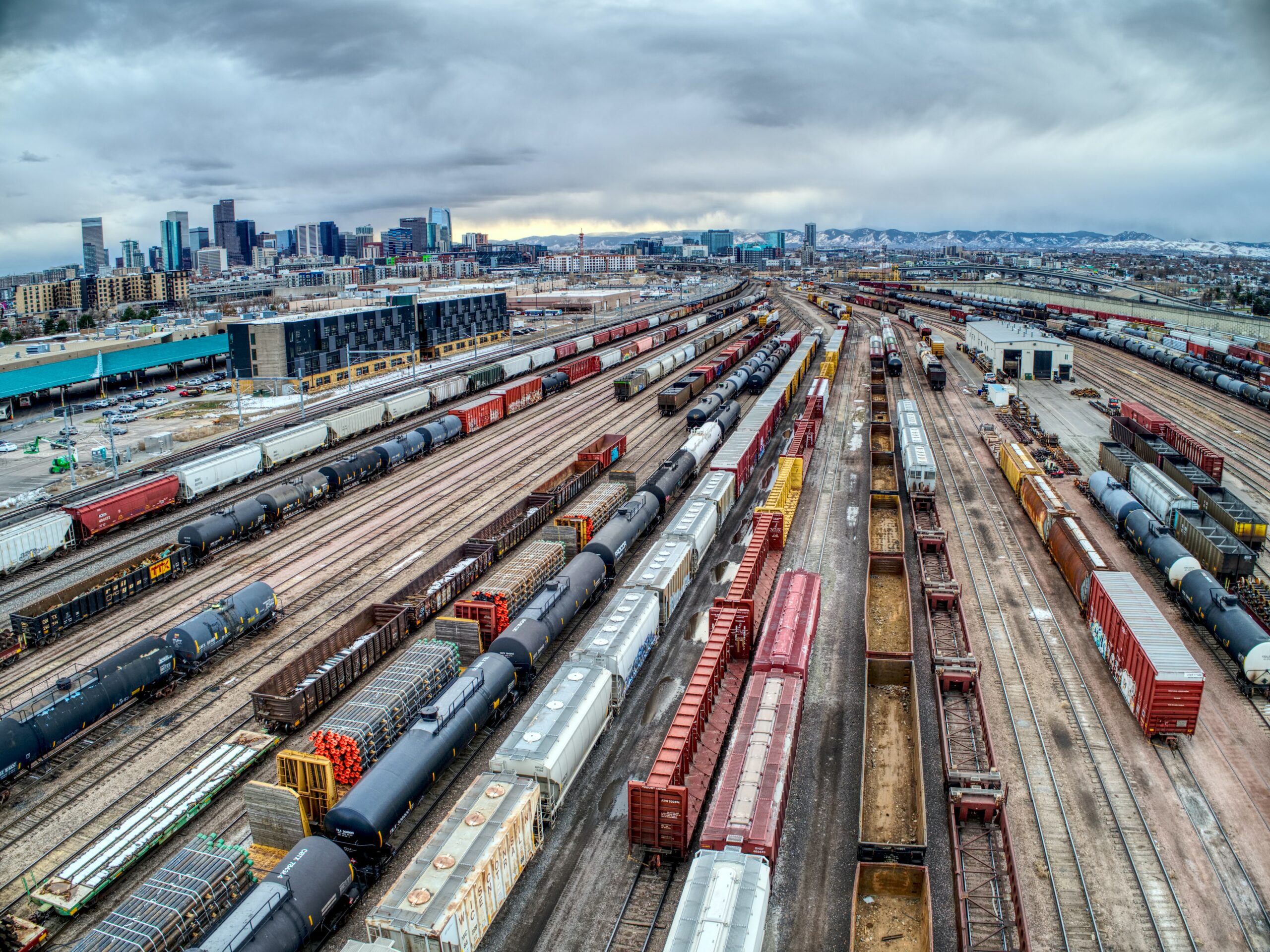
Floodwater from the Rio San Jose cut BNSF’s Southern Transcon near Laguna, New Mexico, on October 24. RailState’s sensors show trains moving through the washout about 61 hours later, and the line clearing its backlog faster than its normal pace.
At a Glance
- Up to 8 inches of rain fell in three days around Laguna, in an area that averages less than 10 inches a year. BNSF reported the washout on the evening of October 24 and closed the line.
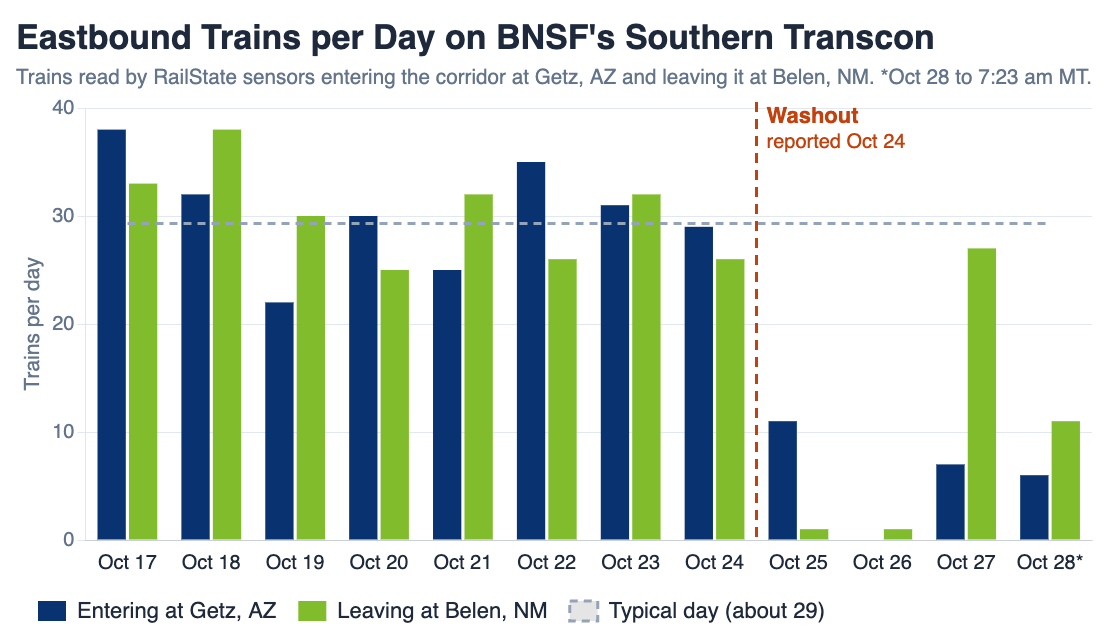
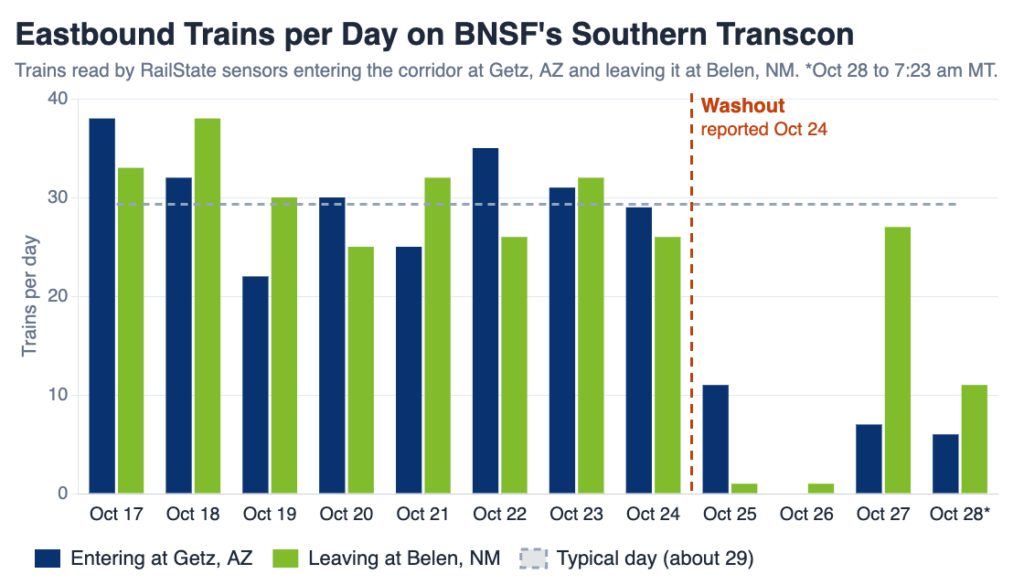
- Eastbound trains leaving the corridor at Belen, New Mexico, fell from about 29 a day to one on each of October 25 and 26.
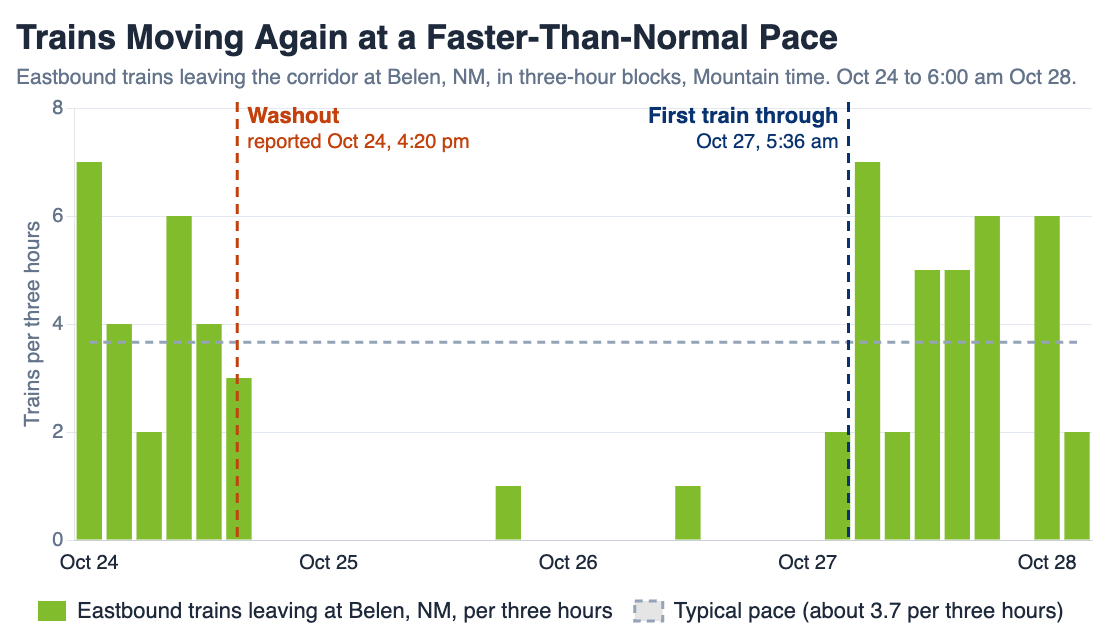
- The first train through reached Belen at 5:36 am Mountain time on October 27, about 61 hours after BNSF’s report. That day, 27 eastbound trains left the corridor, close to normal.
- Through 7:23 am on October 28, eastbound trains were clearing at 1.2 times the normal pace, and westbound trips were back to their usual 17 hours.
What Happened
Heavy rain fell across western New Mexico from October 22. By October 24, the National Weather Service estimated that 3 to 8 inches had fallen over three days along the Rio San Jose (National Weather Service). Nearby Grants averages 9.67 inches in a full year (NOAA normals). Grants and Milan declared flooding emergencies, and Cibola County moved toward a disaster declaration (Cibola Citizen).
The river took out BNSF’s main line between mileposts 69.7 and 72.7 of the Gallup Subdivision near Laguna, on the Southern Transcon between Los Angeles and Chicago. BNSF received a preliminary report at 5:20 pm Central time on Saturday, October 24, and closed the line (Trains). Amtrak cancelled all or part of three Southwest Chief trains (Railway Supply).
Repairs began on Sunday, but more rain that night delayed the reopening. BNSF’s October 26 advisory said one main track would return that afternoon, with trains running on a single track through about 12 miles of the repair area (Trains).
Where Our Sensors Are
RailState has trackside sensors at both ends of the affected stretch: at Getz, Arizona, west of Kingman, about 440 rail miles west of the washout, and at Belen, New Mexico, about 70 miles east of it. Each reads every passing train and the railcars and containers aboard.
Two Days With Almost No Eastbound Trains
On a typical day, about 29 eastbound trains enter the corridor at Getz and 29 leave it at Belen. After the washout, Belen saw one eastbound train on October 25 and one on October 26. Eastbound trains entering at Getz fell to 11 on October 25 and none on October 26. Westbound trains entering at Belen fell from about 32 a day to five, then four.
Trains Moving Again in 61 Hours
The first eastbound train through the washout reached Belen at 5:36 am Mountain time on October 27, about 61 hours after BNSF’s report. That day, 27 eastbound trains left the corridor at Belen, close to the typical 29.
From the first train through to 7:23 am on October 28, Belen read 38 eastbound trains carrying about 6,400 containers, about 1.5 trains an hour against a typical 1.2. A normal stretch of the same length would bring about 31 trains and 5,100 containers.
A Quick Recovery Given the Scale of the Flooding
BNSF faced up to 8 inches of rain in three days, a river over its banks, and a second round of rain that delayed its first reopening. Even so, trains were moving through the washout in about two and a half days, and the line passed nearly a normal day’s eastbound traffic on its first day back while running on a single track through the repair area.
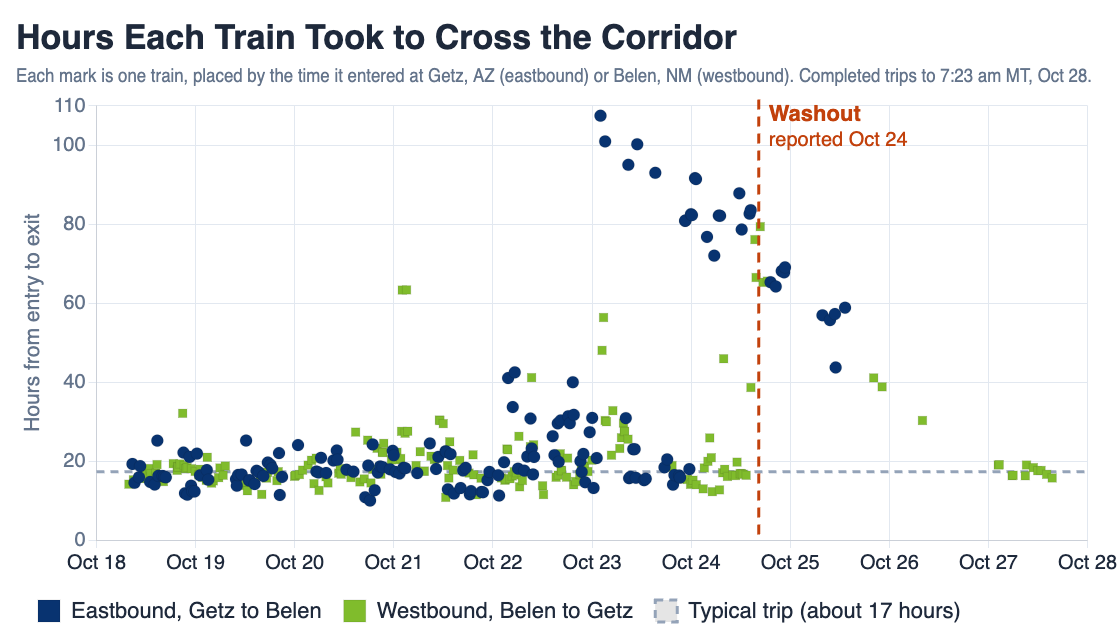
Journey times tell the same story. A typical trip between Getz and Belen takes about 17 hours. Eastbound trains held through the closure took up to 107 hours. Westbound trains that entered at Belen after the reopening took 16 to 19 hours, a normal trip.
What Is Still Clearing
As of 7:23 am on October 28, 36 eastbound trains that entered at Getz from October 23 onward had not yet reached Belen, down from 40 the afternoon before. Thirty are intermodal trains, carrying about 7,700 containers.
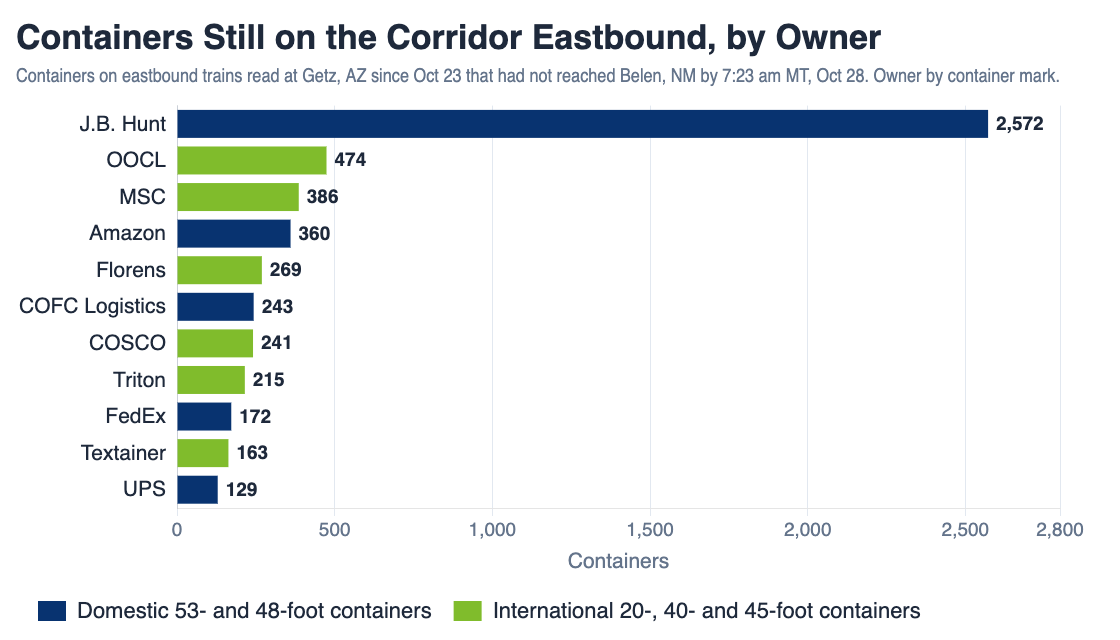
Because RailState reads each container number, we can see whose boxes are waiting. J.B. Hunt has the most, about 2,600, followed by OOCL with about 470, MSC with about 390, and Amazon with about 360. Owners are counted by the marks on the boxes, so leased containers count under lessors such as Florens, Triton, and Textainer. About 1,100 containers could not be read.
Fewer new trains are entering the corridor than usual: 7 eastbound at Getz on October 27 and 6 by 7:23 am on October 28, against a typical 29. That is consistent with BNSF clearing the trains already on the corridor before adding more.
Why This Measurement Matters
News of a washout tells shippers that a line is closed, not how many trains are held, how fast the line is recovering, or when their freight will move. Measured train by train, that picture lets shippers reroute, rebook, or reset delivery dates based on what’s really happening. It also gives analysts and investors an accurate, timely read on volumes through one of North America’s most important freight corridors, at the level of individual trains and containers.
What We Are Watching
- How quickly the remaining eastbound trains clear the corridor
- When eastbound trains entering at Getz return to their usual 29 a day
- When BNSF restores the second main track, and how that affects journey times
RailState’s sensors will show each of these as it happens.