
How Bad is the Rail Bottleneck in Chicago?
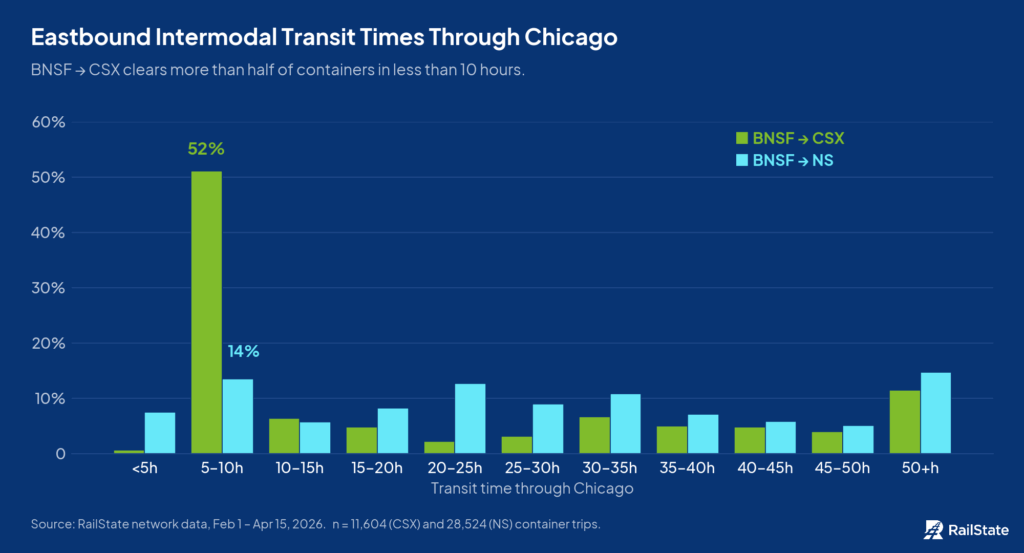
RailState network data shows that under existing cooperation agreements, half of CSX-bound containers already cross Chicago in less than 10 hours
The Union Pacific–Norfolk Southern merger application argues that cross-continent freight interchange in the United States is fundamentally broken, and that only end-to-end, single-line ownership can fix it. A transcontinental railroad would bypass the handoffs between western and eastern carriers altogether. Chicago is held up as the most visible symptom. Six Class I railroads transfer cars and containers there, and the filing calls the result a chronic bottleneck that slows every shipment passing through.
That claim can be tested against direct measurement. Between February 1 and April 15, 2026, RailState recorded the eastbound movement of 40,128 intermodal containers (71% routed onto NS, 29% onto CSX) and 2,809 grain cars (51% to CSX, 49% to NS) from BNSF lines west of Chicago to CSX and Norfolk Southern lines east of the city.
Does the data support what the merger filing describes?
How RailState measures the interchange
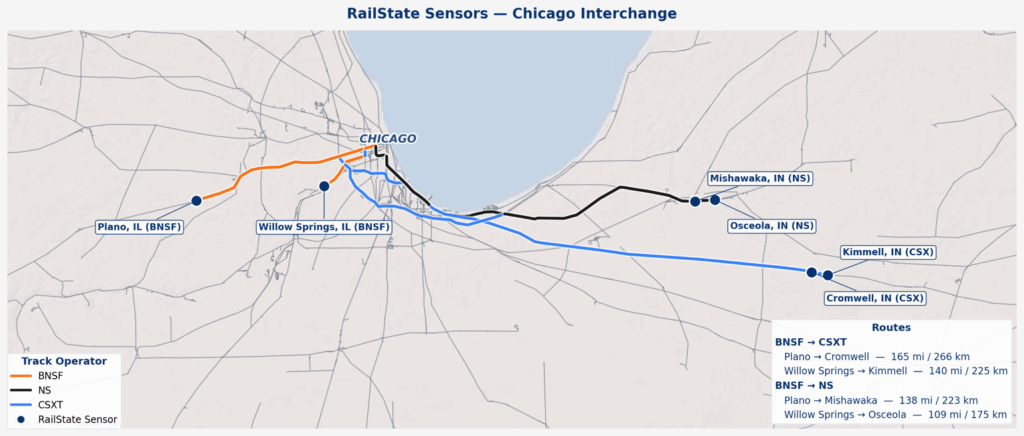
RailState operates a network of trackside sensors across the U.S. rail system. For this analysis, sensors on BNSF lines west of Chicago, paired with sensors on CSX and NS lines east of Chicago, captured every eastbound train passing through. Matching the same car or container at the western and eastern detections gives us transit time across the interchange. This include both steel wheel interchange and containers crosstown drayed between Chicago-area terminals onto another railroad. Where the same locomotives appear at both detections, we can also see when power is carried through onto the receiving railroad.
Half of CSX-bound intermodal traffic crosses Chicago in less than 10 hours
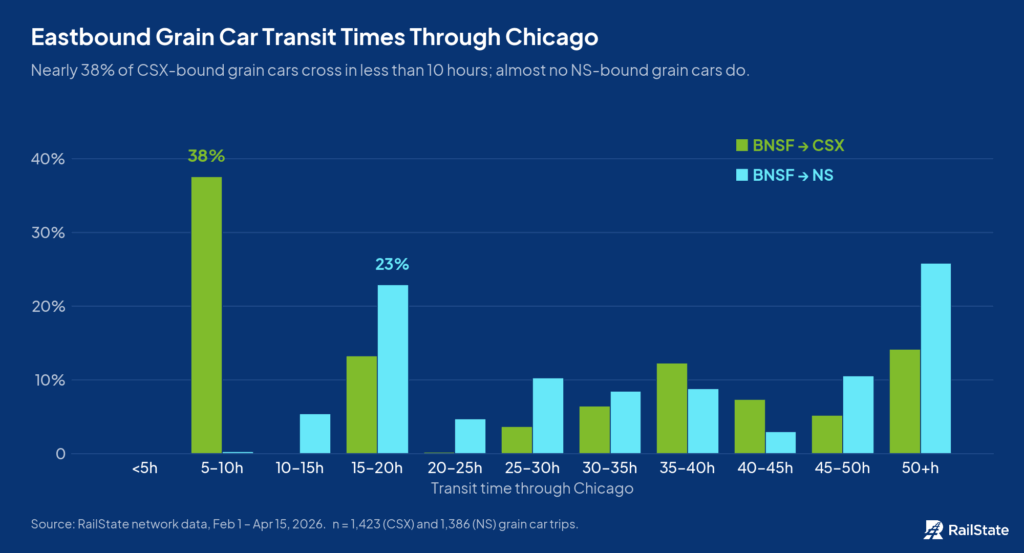
BNSF-to-CSX intermodal traffic moves through the interchange faster than BNSF-to-NS traffic, and far faster than the bottleneck framing suggests. Just over half (52%) of containers handed from BNSF to CSX clear the region in less than 10 hours. The average is 21.5 hours. CSX-bound grain unit trains are similarly quick. Nearly 38% complete the move in less than 10 hours. Only about a fifth of NS-bound containers and well under 1% of NS-bound grain cars finish the same trip as quickly.
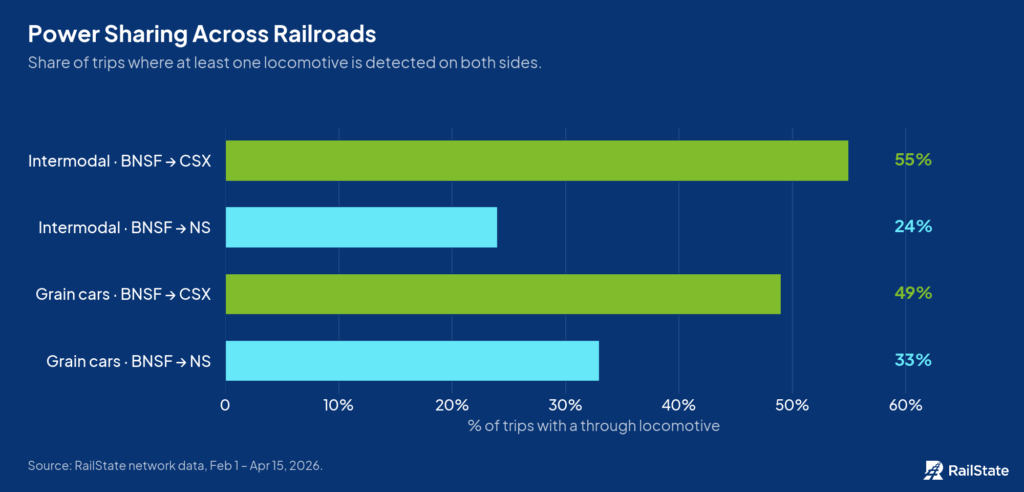
The locomotive data adds context. Over half of BNSF-to-CSX intermodal trips and roughly half of BNSF-to-CSX grain unit trips show at least one locomotive detected at both the western (BNSF) and eastern (CSX) sensors. The same locomotive that pulled the train across the BNSF appears on CSX track east of Chicago, consistent with locomotives continuing onto the receiving railroad rather than being swapped at a yard.
Slower and More Variable Connecting to NS
The BNSF-to-NS corridor is slower on average. Intermodal averages 28.4 hours; grain averages roughly 36 hours. The distributions are also more spread out. Even so, about 24% of NS-bound intermodal trips and 33% of NS-bound grain car trips show a locomotive carrying through to NS.
Distance does not explain the travel time gap. The BNSF-to-CSX route between sensors is the longer of the two. The NS route is shorter, but it threads through the densest part of the Chicago network.
A measurable claim
The merger application rests on a premise about operational performance. RailState’s network data show that at the country’s largest eastbound handoff, more than half of CSX-bound intermodal traffic and roughly half of CSX-bound grain unit trains already cross the city in less than 10 hours, whether by rail-to-rail interchange or by drayage between terminals onto the receiving carrier. For about half of the BNSF-to-CSX trips, the same locomotives are detected at both sensors, indicating power moving directly between carriers. Fast movements through Chicago are possible today, under the current infrastructure and the railroad agreements already in place. The NS route is meaningfully slower. Even there, a significant minority of trips are fast.
Chicago does have real congestion. The question regulators face is whether the gains attributed to a transcontinental, single-line railroad are large relative to what existing cooperation agreements already deliver where the network is used most heavily. The data needed to answer that is being recorded train by train, every day.
The remaining question is whether the merger application will be evaluated against it.
